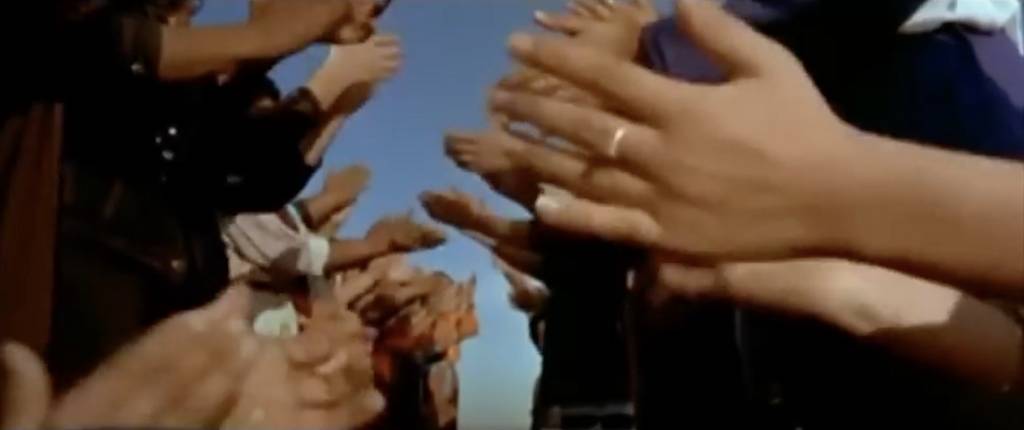
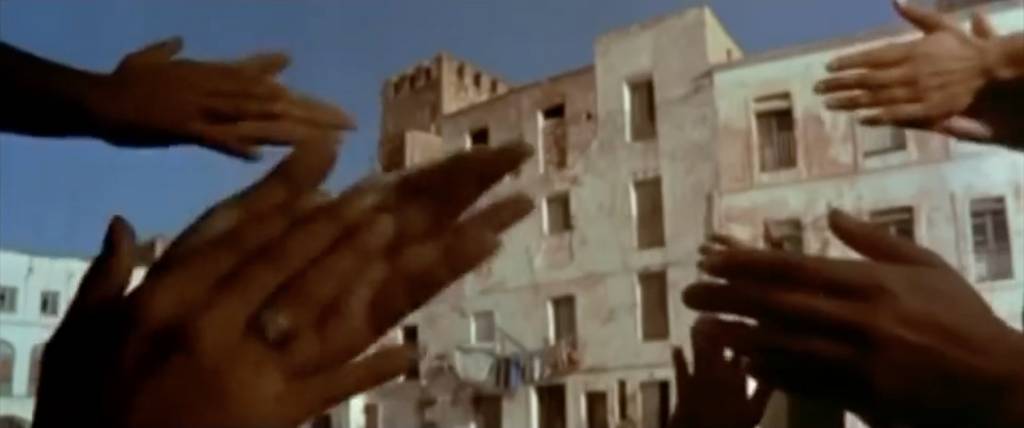
Via Wikipedia: "The movie is about the Romani people's journey from north-west India to Spain, consisting primarily of music. The film was screened in the Un Certain Regard section at the 1993 Cannes Film Festival.
The film contains very little dialogue and captions; only what is required to grasp the essential meaning of a song or conversation is translated. The film begins in the Thar Desert in Northern India and ends in Spain, passing through Egypt, Turkey, Romania, Hungary, Slovakia, and France. All of the Romani portrayed are actual members of the Romani community. [...]
The use of music in the film is highly important. [...] The film relies on music to convey emotion and tell the story of the Romani. Musicians include the Romanian group Taraf de Haïdouks, La Caita (Spain), Remedios Amaya and gypsy jazz guitarist Tchavolo Schmitt.
The soundtrack was composed by Dorado Schmitt, who appears in the film."
Students in my Visual Music class acquire knowledge of design principles and techniques by producing visualisations of sound/music – e.g. as installations, videos clips, VJ sets, installations, and computer games.
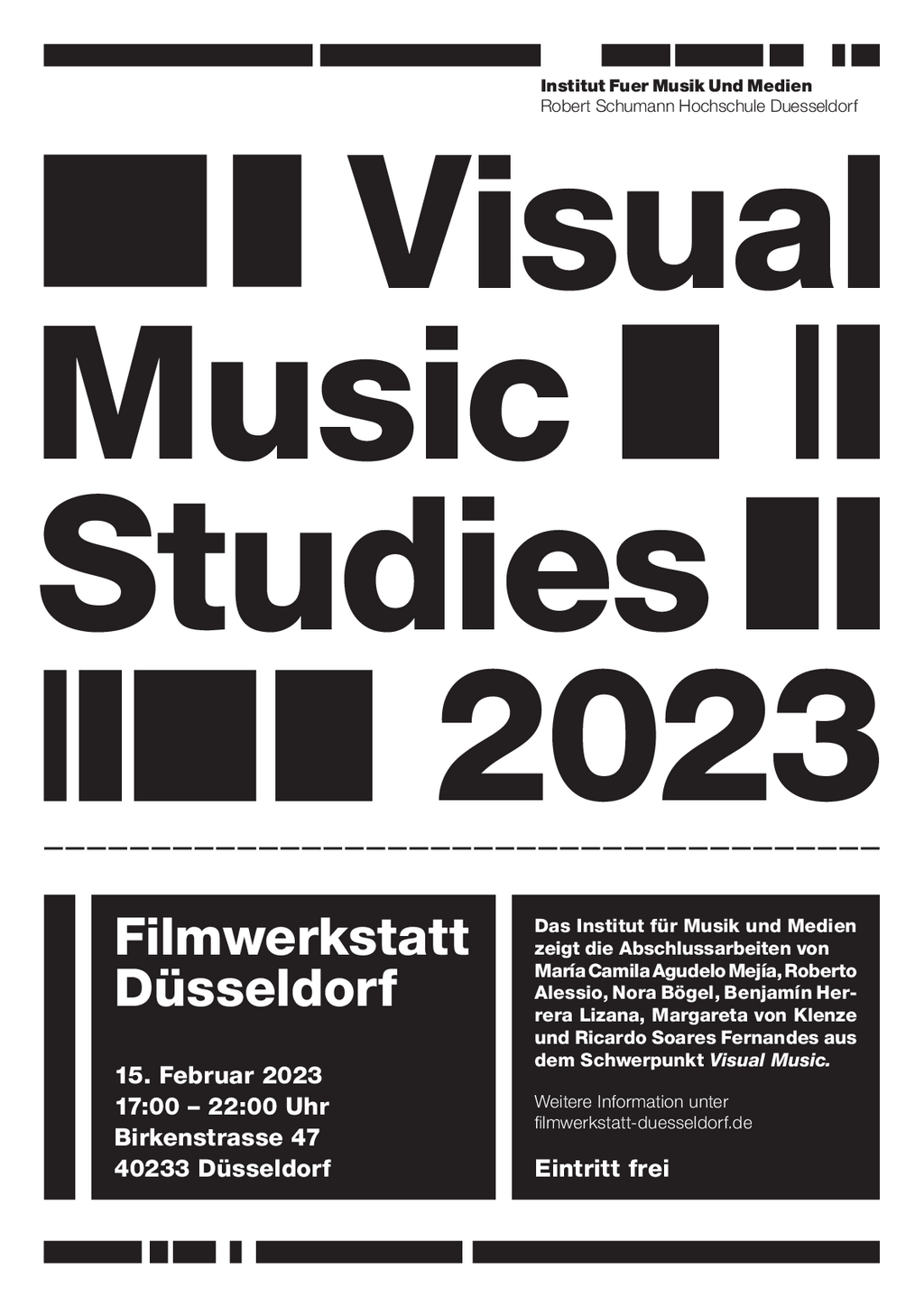
Visual Music Studies 2023
Annual show of student's Visual Music projects February 15th, 2023
Every year composer and assistant professor Marcus Schmickler and I host the Visual Music Studies at Dusseldorf's Filmwerkstatt. This year's class - María Camila Agudelo Mejía, Roberto Alessio, Nora Bögel, Benjamín Herrera Lizana, Margareta von Klenze, und Ricardo Soares Fernandes - will show their studies on February 15th, 2023.
Creating a work for this show is part of the assignment in my Visual Music class at the Institute for Music and Media at Dusseldorf Robert Schumann conservatory. Many of the students decide to show a transmedia installation, but some of them are also interested in video clips, experimental films, and animations as well as audiovisual performances.
American Magus (2002) is a documentary by Paolo Igliori about Harry Smith (1923-1991) – compiler of a famous three-part folk album, film-maker, painter, anthropologist, obsessive collector and thinker.
Via MUBI: "A documentary about the brilliant and versatile cult figure Harry Smith (1923-1991) – compiler of a famous three-part folk album, film-maker, painter, anthropologist, obsessive collector and thinker."
Via Wikipedia: "Paola Igliori (born in Rome, Italy), is a poet, writer, photographer, essayist and publisher. She became a resident of New York City from the 1980s, when she first moved there, until 2003 when she returned to her home country. [...]
In 1996, she edited and published American Magus: A Modern Alchemist, a book about then largely unknown (though well known among artists, since the 1950s) American artist, painter, poet, film maker, essayist and collector Harry Everett Smith. Igliori had developed a strong personal relationship with Smith, who, by some accounts, died in 1992 in her arms "singing as he drifted away", at the Hotel Chelsea.[3] In 2001, she wrote and directed a documentary about Smith, titled American Magus."
Via Create Digital Media: "It’s synthesis from paper – sounds crafted quite literally by hand, using drawn animation, then optically synthesized. But after this 4K restoration, it’s clear how much these 1930s inventors were ahead of their time.
I first saw this animation, like a lot of people, via Moscow-based historian Andrey Smirnov, who writes the following description of artist Voinov for Austria’s Institut für Medienarchäologie:
'Nikolai Voinov (1900-58) began his career as an animator in 1927. In 1930 he was involved in the production of the first drawn ornamental soundtracks at Avraamov’s Multzvuk laboratory. In 1931 he left and started his own research at the Cartoon Studio of the Moscow Film Factory as a developer of ‘Paper Sound’ techniques. These were based on the synthesis of sound waves by means of paper cutouts with the carefully calculated sizes and shapes produced by his newly invented tool, the Nivotone. (Andrey Smirnov)'.
You get a full roster of paper-optical synthesis. (It’s hard to even know what to call that – it’s essentially a hybrid of optical-analog synthesis machines and traditional cell animation or other hand-drawn techniques.)
That includes: • Variophone – Evgeny Sholpo, 1930 Leningrad / Lenfilm (who also works with the legendary Georgy Rimsky‐Korsakov • Working directly on optical track of the film – Arseny Avraamov (who also had his own 48-tone microtonal system) – he worked across the USSR and Germany • Paper sound techniques – Nikolai Voinov (Nivotone) • Anushen Ter-Ghevondyan – Armenian composer and audiovisual inventor based in Yerevan at the Soviet studio there (I have fairly sketchy notes, presumably worth a separate research), also worked with paper, animation, and optical synthesis [...]
The variophone itself was tragically lost in a missile attack in the Siege of Leningrad, meaning this is another thing to blame on Nazis this week – although futuristic electronic music sometimes had the Soviet bureaucracy as a foe, too. (So it is with those who advance culture, I’m afraid, generally.)"
Anne Collier at Galerie Neu. Images courtesy of the artist; Anton Kern Gallery, New York; Galerie Neu, Berlin; and The Modern Institute/ Toby Webster Ltd., Glasgow. Photos by Stefan Korte.
Via The New York Times: "A decade before Walt Disney Productions came into existence, making its name synonymous with animated films, there was another pioneer of the art form — Lotte Reiniger.
Reiniger’s filmmaking career spanned 60 years, during which she created more than 70 silhouette animation films, including versions of 'Cinderella,' *Puss in Boots' and 'Hansel and Gretel.' She’s perhaps best known for her 1926 silent film 'The Adventures of Prince Achmed,' a fantastical adaptation of 'The Arabian Nights' that was among the first full-length animated features ever made. [...]
Reiniger’s editing was meticulous. Starting with more than 250,000 frames, she and her crew used just over 100,000 in the film, which ran for an hour and 21 minutes, each second requiring 24 frames. It took three years to complete, and premiered in the Volksbühne, or People’s Theater, in Berlin, when Reiniger was 27. [...]
Beginning with 'Prince Achmed,' she also created an early version of the multiplane camera, which gave two-dimensional animation a hitherto unexplored depth, movement and complexity. She called her device a tricktisch, or trick table.
Reiniger described her process this way: 'Figures and backgrounds are laid out on a glass table. A strong light from underneath makes the wire hinges disappear and throws up the black figures in relief. The camera hangs above this table, looking down at the picture arranged below.'
After taking a photograph, Reiniger and her team moved the figures into their next position and photographed the scene again. 'The important thing,' she wrote, 'is to know how much to move the figures so that a lifelike effect may be obtained.' [...]
She died on June 19, 1981, in Dettenhausen, Germany. She was 82. Though The New York Times did not take note of her death at the time, the Times film critic A.O. Scott recalled her in a 2018 article about the unsung women who had advanced the art of filmmaking.
Praising Reiniger’s 'blend of whimsy and spookiness,' Mr. Scott wrote that her 'dreamy images that seem to tap right into the collective unconscious suggest both an antidote to Disney and a precursor to Tim Burton.' "
[ Latest additions ]
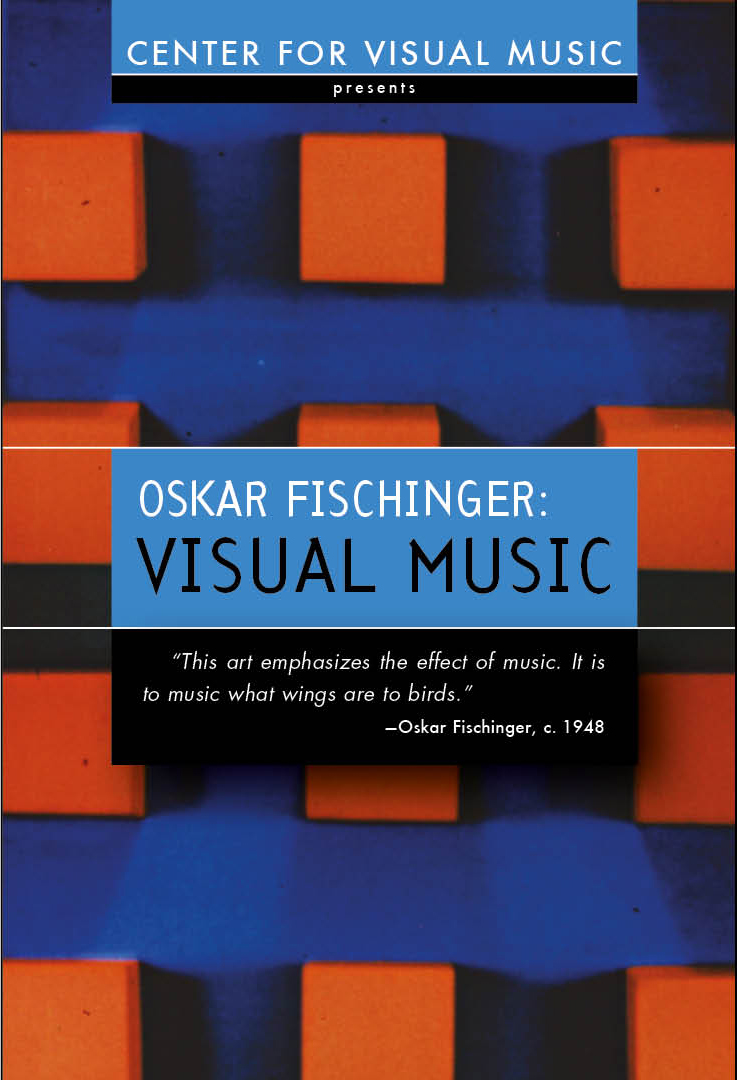
DVD sleeve by Center for Visual Music, Los Angeles.
The wonderful people at the Center for Visual Music released a new DVD with outstanding, classic and rare films by the Father of Visual Music and the great-grandfather of motion graphics.
Via the CVM: "Featuring Fischinger's famous Composition in Blue, Muratti greift ein (the waltzing cigarette ad), Study no. 8, Study no. 5 and Study no. 2 from his groundbreaking series of abstract animation synchronized to music in the 1930s, which screened in first run theatres worldwide. Plus the films Squares, An American March, Pierrette I, Coloratura, Swiss Trip (Rivers and Landscapes), newly restored animation tests from the 1920s, 30s and 40s (many never completed or released), and home movies from the 1920 and 1960s. Region free."
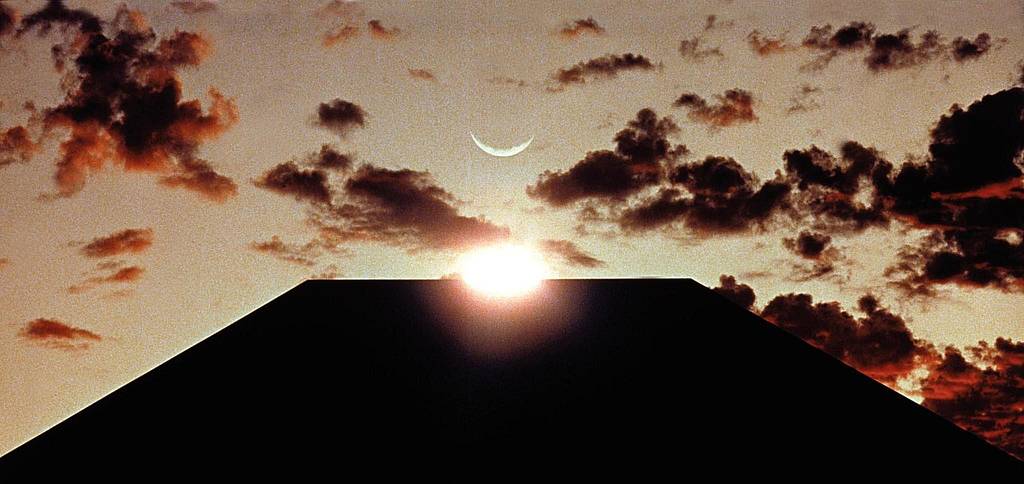
Every time I watch 2001: A Space Odyssey by Stanley Kubrick I can not believe that it was delivered in 1968. Set to the mind blowing sounds of Requiem, Atmospheres and Adventures by György Ligeti the Star Gate sequence by Douglas Trumbull remains a challenge.
Mary Ellen Bute (1906-1983), still from Synchromy No. 4: Escape, 1937-38
Mary Ellen Bute is the experimental artist we need right now
This Animation Pioneer Turned Music into Pure Light
Via the Creators Project: "With kaleidoscopic and surreal imagery that dances across the screen in perfect succession to its musical accompaniment, the film and animation of Mary Ellen Bute puts the viewer in an alluring dreamlike world where music is not only heard but also seen. Active from the 1930s until her death in 1983, Bute was on a continued quest to unite images and sound through her work. In this pursuit she explored many different tactics of animation and experimental filmmaking, most famously oscilloscope-generated imagery. The latter practice involves using the oscilloscope, an instrument designed to observe and track electrical signals and use information about voltage and configuration gained from this process to describe shapes. Bute began filming the images generated by music she fed through this instrument. Cindy Keefer a curator, archivist, and director for the Los Angeles based Center for Visual Music (CVM) explains, 'She then combined those images with that same music and layers of animation. Other animators began to film oscilloscopes after this, but her work makes her one of the earliest, and a pioneer in electronic art.' [...]
As the rise of the internet and emerging visual and audio technology makes the relationship between audio and visual art more analogous, it's important to look back on the pioneers whose work paved the way for these developments. Mary Ellen Bute was not the kind of person satisfied with letting her ideas remain abstract thoughts, stating in 1936, 'We need a new kinetic, visual art form - one that unites sound, color and form.' Looking at her oeuvre in hindsight, it is clear the work is a well thought out experiment in seamlessly combining these elements."
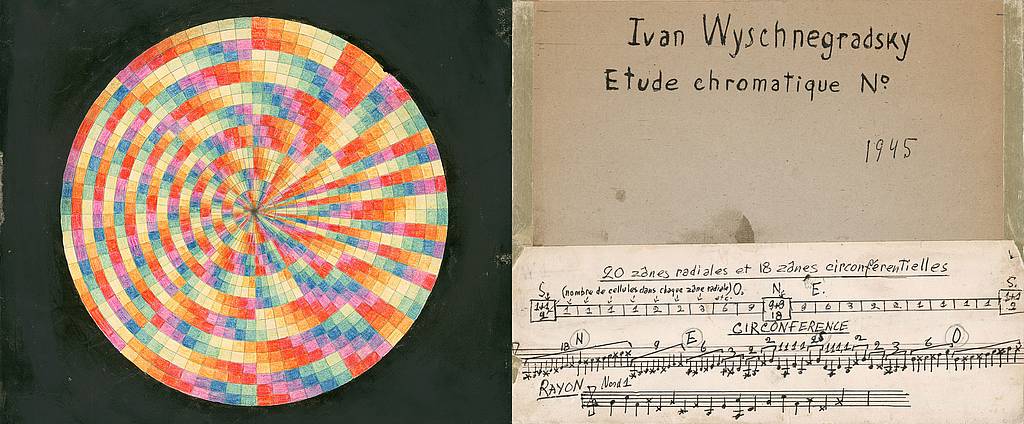
Via Slate: "Russian composer Ivan Wyschnegradsky was a 20th-century avant-garde pianist devoted to 'creating a work capable of awakening in every man the slumbering forces of cosmic consciousness,' according to his journal. To achieve this mystical ideal, he set out to create sounds that no one had ever heard before. His music was microtonal, a style that transcends the limitations of the 12-scale tuning system in traditional Western music. [...]
In the late 1940s, he translated his ultrachromatic compositions into these mesmerizing rainbow color wheels. He applied the concepts of synesthesia, blurring the line between sound and color. Each cell on these drawings corresponds to a different semitone in his complex musical sequences. If you look closely enough, you can follow the spirals as if it were a melody and listen to the scores they represent."
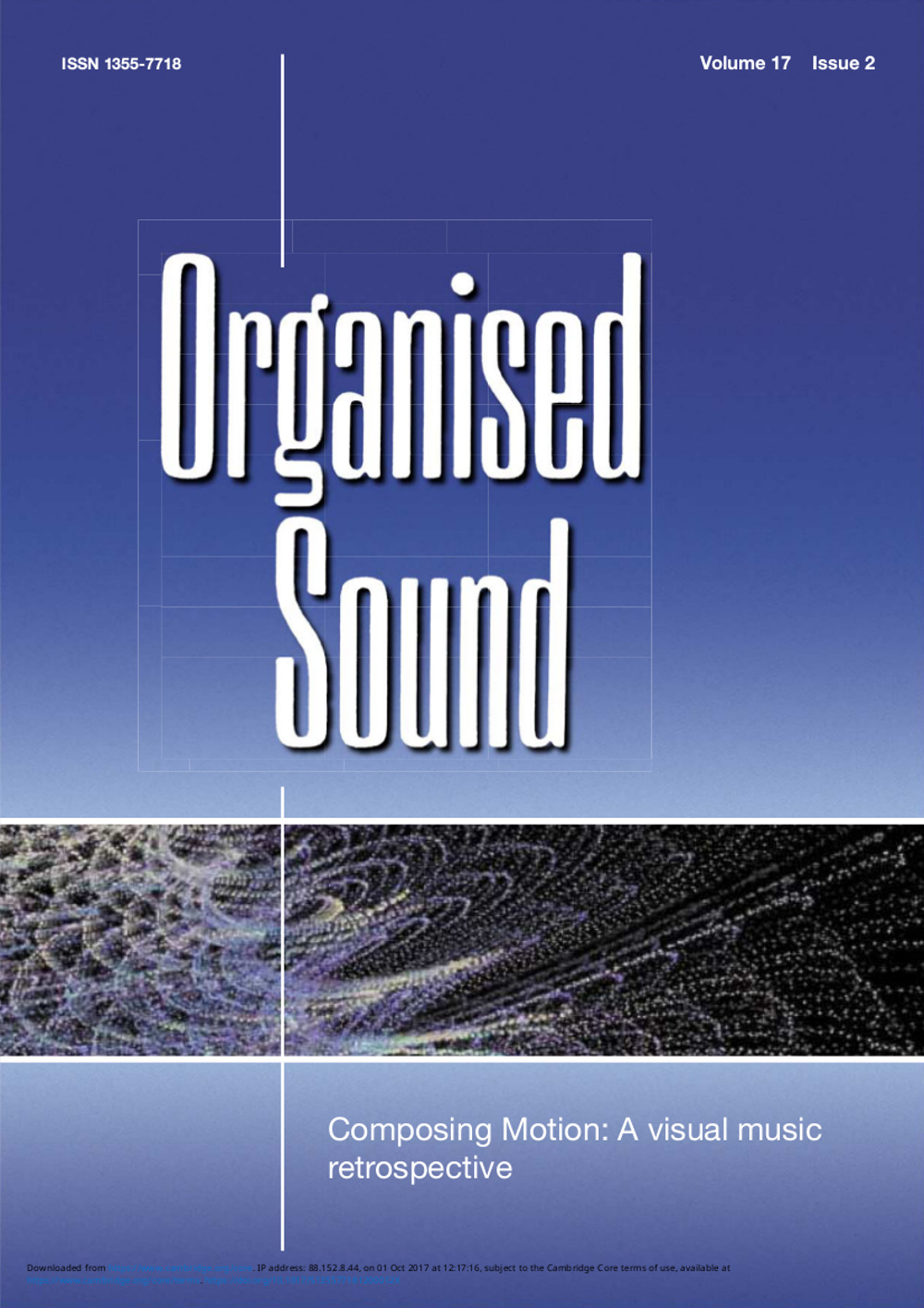
Editorial by Nick Fox-gieg, Cindy Keefer, Margaret Schedel
From sonic art to visual music: Divergences, convergences, intersections by Diego Garro This paper introduces strategies for the electroacoustic community to relate to, and engage with, the visual music phenomenon. It addresses technological, historical, cultural and idiomatic intersections between the two art forms. From the personal viewpoint ...
Consonance and dissonance in visual music by Bill Alves The concepts of consonance and dissonance broadly understood can provide structural models for creators of visual music. The application of words such as 'harmony' across both music and visual arts indicates potential correspondences not just between ...
Translation, emphasis, synthesis, disturbance: On the function of music in visual music by Anton Fuxjäger Starting from the premiss that the central aesthetic feature of non-representational moving images (visual music) is their structuring of reception time, the function of the accompanying music in contributing to the total (combined) temporal structure ...
The evolution of notational innovations from the mobile score to the screen score by Lindsay Vickery This article examines the evolution of music notational practices from avant-garde-era experiments in 'mobility' to the advent of the digital 'screen score'. It considers the varied goals of the composers who initiated these developments and the dissonance ...
The oramics machine: From vision to reality by Peter Manning The pioneering contributions of Daphne Oram to visual music, notably the construction of her unique synthesiser known as the Oramics Machine during the 1960s, have yet to be fully recognised. The development of this synthesiser, in terms of both the ...
Audiovisual harmony: The realtime audiovisualisation1 of a single data source in construction in zhuangzi by Ryo Ikeshiro This paper explores the context and technical and aesthetic considerations behind the author's generative and improvisational audiovisual work, Construction in Zhuangzi (2011), and in particular the approach of 'audiovisualising' the same source ...
Depth modulation: Composing motion in immersive audiovisual spaces by Ewa Trębacz The field of electroacoustic music has witnessed years of extensive exploration of aural spatial perception and an abundance of spatialisation techniques. Today the growing ubiquity of visual 3D technologies gives artists a similar opportunity in the ...
Visual music after cage: Robert breer, expanded cinema and stockhausen's originals (1964) by Andrew v. Uroskie Within William Seitz's 1961 exhibition The Art of Assemblage for the New York Museum of Modern Art, the question of framing-of art's exhibitionary situation within and against a given environment-had emerged as perhaps the major issue of postwar ...
Musique concrète thinking in visual music practice: Audiovisual silence and noise, reduced listening and visual suspension by Joseph Hyde This article is based on my creative practice as an electroacoustic composer who has developed a practice of audiovisual composition broadly sited within the field of visual music. A brief contextual survey sites my work by first presenting a personal ...
Acousmate: History and de-visualised sound in the schaefferian tradition by Brian Kane The word acousmatic has a strange and complicated history. Recent Schaefferian accounts have replicated François Bayle's sketch of the histoire du mot from his Musique acousmatique-in particular, the assumed synonymy between acousmatique ..."